WHAT BODY RECOMPOSITION MEANS
Many women over 40 notice that the number on the scale does not tell the full story. You may be exercising regularly and eating well, yet your clothes fit differently, your energy shifts, or your body looks different even when your weight stays the same. This is where body recomposition becomes a useful way to think about progress.
Body recomposition focuses on changing what your body is made of rather than only how much it weighs. The goal is to support muscle while gradually reducing body fat. Two women can weigh exactly the same and look very different depending on how much muscle and fat they carry.
This matters more with age. As we get older, we naturally tend to lose some muscle unless we actively maintain it. Perimenopause and menopause can also bring changes in sleep, recovery, energy, and where the body stores fat. Because muscle supports strength, metabolism, bone health, and everyday function, protecting it becomes an important priority for women in midlife.
Focusing only on the scale can also be discouraging. If you build strength while losing fat, your weight may change slowly even though your body is changing in meaningful ways. Looking at the bigger picture helps you recognize progress that a scale cannot show.
Signs the scale may not be telling the whole story include:
- Clothes fit differently
- Strength is improving
- Energy is more consistent
- Daily tasks feel easier
- Posture is improving
- Measurements are changing
- Recovery is getting better
It is also important to be realistic. Body recomposition is a gradual process, and results vary from person to person based on training history, nutrition, sleep, stress, age, and overall health. A thoughtful approach focuses on steady progress and habits you can keep.
Understanding what body recomposition means is the first step toward setting goals that reflect how you want to feel and function, not only what you want to weigh.
HOW IT WORKS AFTER 40
Successful body recomposition usually comes down to a few fundamentals working together: strength training, adequate protein, sensible nutrition, recovery, and consistency. None of these are complicated on their own, but combining them in a way that suits your life takes planning.
Strength training is the foundation. Lifting weights or using resistance challenges your muscles and signals your body to maintain and build them. For women over 40, this is also one of the best ways to support bone health and daily function. Progressing gradually and using good technique helps you train safely and effectively.
Nutrition supports that training. Eating enough protein across the day provides the building blocks your muscles need, while balanced meals provide the energy to train and recover. Extreme restriction can work against you, especially in midlife, because it can make it harder to recover and to keep muscle. A moderate, sustainable approach tends to be easier to maintain.
The key building blocks include:
- Regular strength training
- Adequate protein
- Balanced, sustainable nutrition
- Quality sleep
- Stress management
- Rest and recovery
- Patience and consistency
Recovery deserves just as much attention. Muscle is built during recovery, not only during workouts. Sleep, stress, and rest days all influence how well your body adapts. Pushing harder every day without enough recovery can leave you feeling depleted and make progress harder.
Measuring progress in more than one way can also help you stay motivated. Strength numbers, photos, measurements, and how you feel day to day all provide useful information. At Jensen Fitness, tools such as the Fit3D body scanner can provide a detailed look at measurements and body composition over time, so you can see changes the scale may miss.
The most important point is that body recomposition is not a short-term project. It is built from habits repeated over weeks and months, and the approach that works best is the one you can maintain.
HOW COACHING HELPS
Knowing the fundamentals is one thing. Applying them week after week, around work, family, and everything else in your life, is another. This is where coaching can make a meaningful difference.
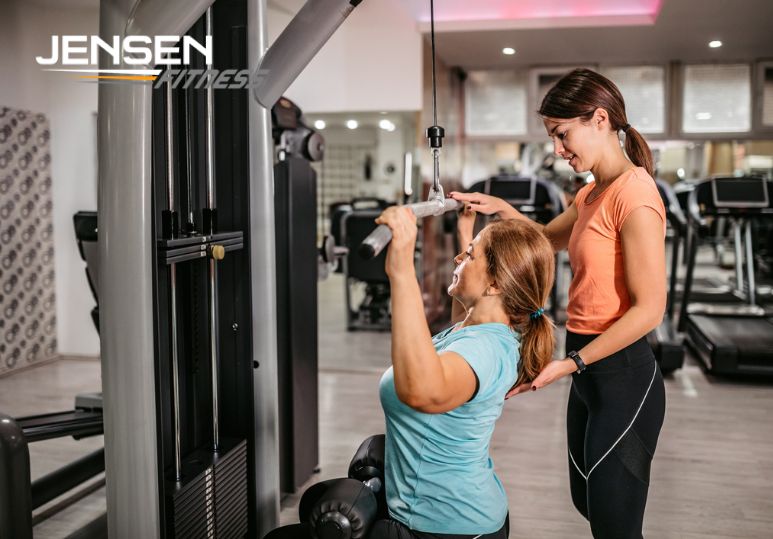
A coach who works with women in midlife can build a plan around your goals, your schedule, your training experience, and any limitations you have. Instead of following a generic program, you get guidance that adapts as your body and your circumstances change.
Accountability is another benefit. Regular check-ins help you stay consistent when motivation dips, and a coach can help you adjust when something is not working instead of giving up. Many women find that having someone in their corner is what turns good intentions into steady progress.
Questions worth asking a coach include:
- How do you personalize training for women over 40?
- How will we track progress beyond the scale?
- How do you approach nutrition and protein?
- How do you factor in recovery and sleep?
- How do you work with my doctor or dietitian?
It is also important to know the limits of coaching. A coach does not diagnose conditions or replace medical care. If you have health concerns, take medications, or have questions about symptoms, speak with your doctor or another qualified healthcare provider, and let your coach know so your plan fits your situation.
Be cautious about programs that promise dramatic transformations in a few weeks. Sustainable change comes from consistent training, supportive nutrition, and realistic expectations, and it should leave you feeling stronger and more energized, not exhausted.
If you are curious whether body recomposition is right for you, a free consultation is a good place to start. A conversation about your goals and history can help clarify what a realistic plan looks like. Jensen Fitness offers menopause coaching in Calgary, along with personal training and nutrition support, to help you build strength, confidence, and a body composition that supports the life you want.